History
Cupertino began as a creek with a saint’s name and a crossroads called West Side. For a century it was a district of vineyards and then of prune, apricot and cherry orchards on the western edge of the Santa Clara Valley.

A short history of Cupertino
Cupertino began as a creek with a saint’s name and a crossroads called West Side. For a century it was a district of vineyards and then of prune, apricot and cherry orchards on the western edge of the Santa Clara Valley. It became a city in 1955, and within a generation it was one of the centres of Silicon Valley. This page tells that story in short, with a link to the source for every claim. For the full texts of the old books, see the reading list.
The first people
Before the Spanish came, the Tamyen (or Thamien), a division of the Ohlone, lived throughout the valley [2]. Spanish colonisation followed the founding of Mission Santa Clara de Thamien in 1777 [2]. When Anza’s expedition crossed the plain below the hills in March 1776, Font counted more than a hundred people who came out to meet the column, shouting and signalling the strangers not to go on [4].
Anza’s camp and the name, 1776
In 1776 Juan Bautista de Anza led an expedition from Sonora to found a presidio on San Francisco Bay [2]. On March 25 he crossed a broad plain of oaks and live oaks, turned west along the foot of the hills and halted at the arroyo of San Joseph Cupertino, a place he thought useful only for travellers; from camp he could see the estuary of the bay [3]. The expedition’s diarist and map-maker, Fray Pedro Font, called the plain the Llano de los Robles, the Plain of the Oaks, and found the camp well supplied with water and firewood but without level land for a settlement [4]. The city credits Font with naming the stream, which is now Stevens Creek [2]; it honoured Saint Joseph of Cupertino [1]. Bolton, who translated the diaries, placed the camp a little southwest of today’s town, on Calabasas Creek north of Saratoga, and noted that Cupertino kept the name [3]. The state marked Arroyo de San José Cupertino as California Historical Landmark No. 800 in 1964 [7].
Ranchos and the first settlers, 1839-1862
Under Mexico, Rancho Quito, granted in 1841, took in parts of today’s Saratoga, Campbell and Cupertino [25]. Elisha Stephens, captain of the Stephens-Townsend-Murphy Party, the first wagon train to cross the Sierra Nevada in 1844, settled on the creek in 1848 [8]. He planted about four acres of Mission grapes in the creek bottom and blackberries, which gave his ranch its name, Blackberry Farm [5]. By the 1860s the stream was known as Cupertino Creek, before it was renamed for Stephens with the spelling Stevens [7]. Local storytellers remember him as a grump who served rattlesnake to his guests; in 1862 he left for Kern County, where he died in 1887 [9] [8].
The Cupertino District and its vines, 1870-1900
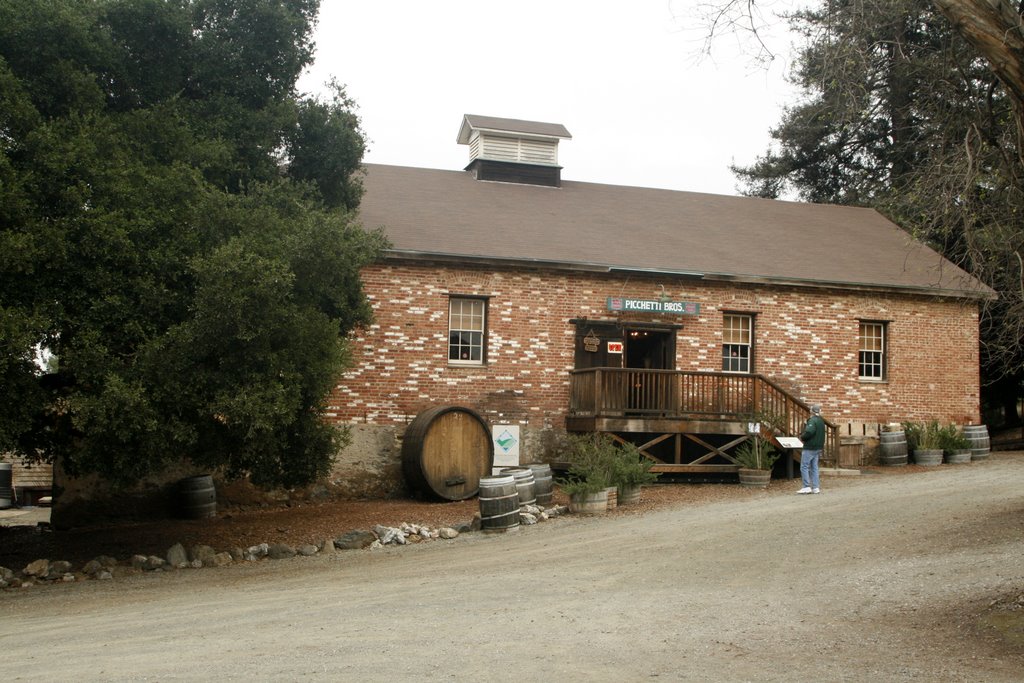
The land around the creek was thin and covered with chaparral, and grain farmers struggled on it [5]. In 1870 S. R. Williams cleared and planted a hundred acres of vines, part of them on Stephens’ old claim, and Norman Porter planted a vineyard in 1871 [5]. When the vines proved themselves, a planting boom followed from 1880 to 1885, by Portal, Thompson, Hall, Doyle, Montgomery, Bubb and others [5]. John T. Doyle, a San Francisco lawyer and historian, named his Cupertino Wine Co. after the creek in the 1880s [2]. On Montebello Ridge, Vincenzo and Secondo Picchetti settled in 1877 and began making their own wine in 1896 [10]. Around 1895 phylloxera, a root louse, destroyed about three quarters of the vineyards in five years, and many growers turned to French prunes, peaches, apricots, cherries, plums, walnuts and almonds [2].
West Side becomes Cupertino, 1880-1920
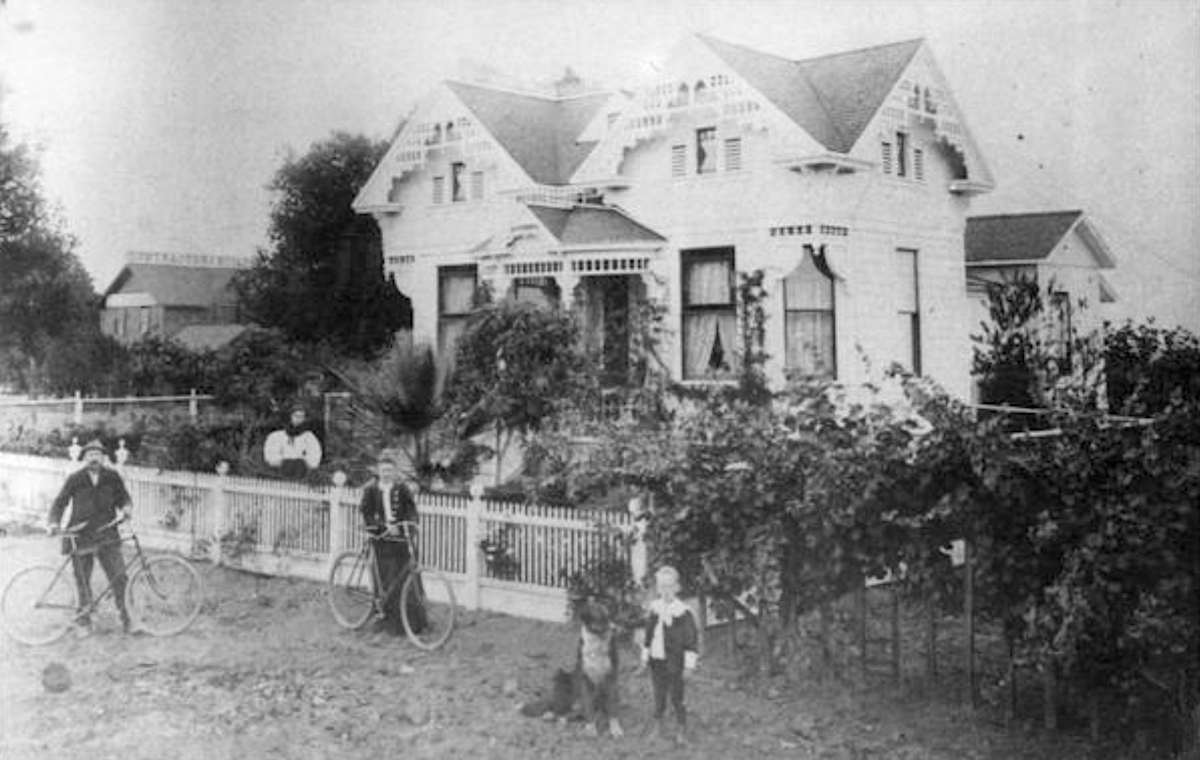
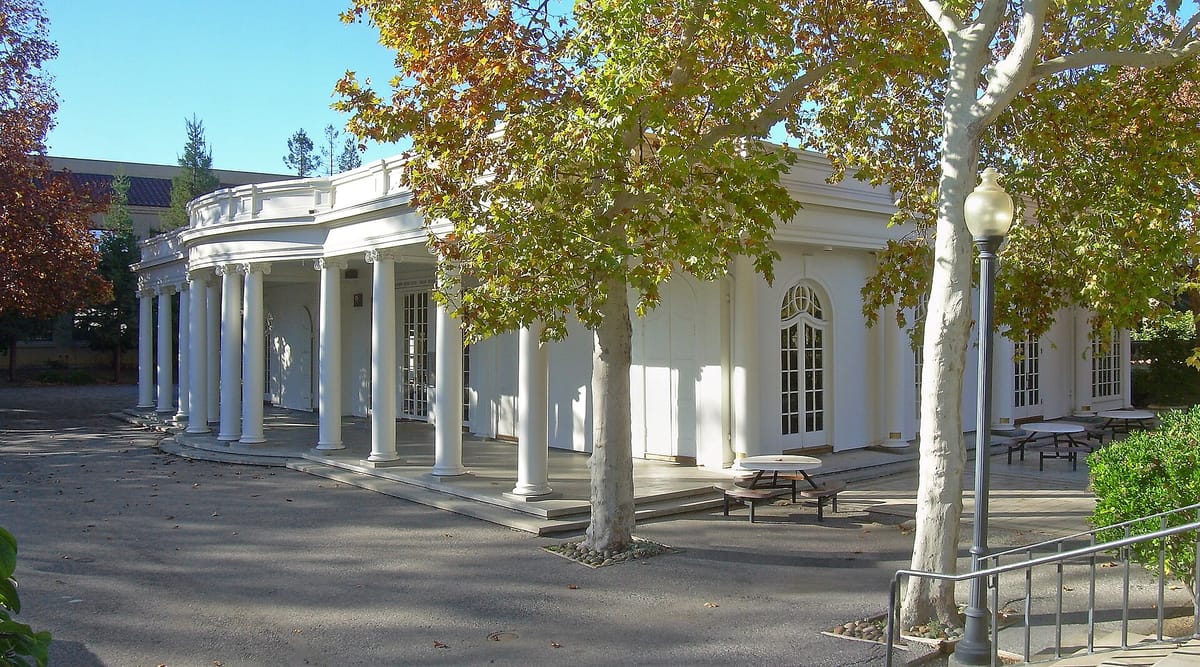
A settlement called West Side grew up at the Crossroads of the Saratoga-Sunnyvale road (now De Anza Boulevard) and Stevens Creek Road [2]. Alexander Montgomery built a store on the corner of his ranch there; it was run by the Home Union for ten years and later incorporated as the Cupertino Store [6]. In 1904, when the post office needed a new name, the name of Doyle’s winery was given to the Crossroads, the post office and the Home Union Store, which became The Cupertino Store [2]. William Baer, a blacksmith from Philadelphia, ran a shop at the Crossroads that served wagons and then the first motor cars [22]. In 1892 Charles and Ellen Baldwin built Le Petit Trianon at the centre of their Beaulieu wine estate, whose wines sold in New York, London and Central America [12]. In 1922 Sawyer’s county history described Cupertino as a town of about 500 people with no fixed boundaries, on the electric railway, surrounded by prune and apricot ranches [6].
The orchard years
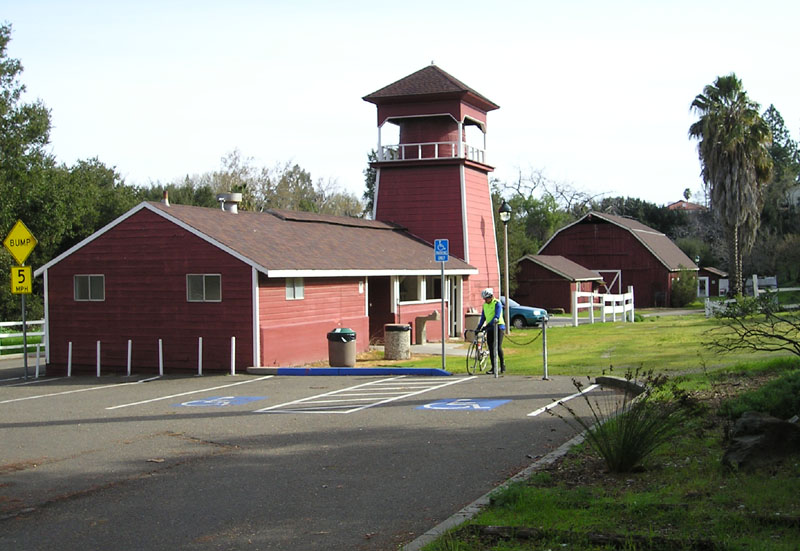
Electric railways and then motor cars brought visitors to see the spring blossom of the Valley of Heart’s Delight, and the electric railway led to Monta Vista, the first housing tract in the Cupertino area [2]. The Picchetti family kept their ranch through Prohibition by growing prunes, apricots and pears and boarding horses [11]. The Leonard family grew prunes and apricots and sold them to Gerber [18]. On the Leonard ranch stood a redwood barn built in 1916 by John Leonard, who had married into the Glendenning family [20].
A city, 1955
After the Second World War the valley’s population boomed, and in 1954 rancher Norman Nathanson, the Cupertino-Monta Vista Improvement Association and the Fact-finding Committee began a drive for incorporation [2]. Voters approved it on September 27, 1955, by 225 votes to 183, and Cupertino became Santa Clara County’s 13th city on October 10, 1955 [1]. Monta Vista decided at the last moment not to join and was annexed piece by piece until 2004 [14]. Rancho Rinconada, a tract of low-cost houses designed by Cliff May and built by Stern & Price in the 1950s, stayed in the county until its residents voted to join the city in 1999 [15].
Vallco, the college and the computer, 1960-1990
In the early 1960s seventeen landowners pooled their land as VALLCO Business and Industrial Park, named for Varian Associates and the Leonard, Lester, Craft and Orlando families [2]. In 1964 Burrel Leonard sold 100 acres of his ranch to Varian [18]. De Anza College opened in 1967 on the 112-acre site of the Baldwins’ winery, and their mansion became the California History Center [2]. Le Petit Trianon was listed on the National Register in 1972, moved twice on the campus and restored in 1982 [13]. Apple arrived in Cupertino in 1977 [2]; its co-founders, Steve Jobs and Steve Wozniak, had graduated from Homestead High School on the city’s northern edge [26]. Vallco Fashion Park opened on September 1, 1976 [17]. In January 1984 Steve Jobs introduced the Macintosh at De Anza’s Flint Center [19]. The cherry trees of Memorial Park arrived from sister city Toyokawa, Japan, in 1983 [16].
Cupertino today
Apple built its Infinite Loop campus in 1993 and made it the company’s headquarters after 1997 [21]. In 2011 Steve Jobs presented the design of a new circular campus to the City Council in his last public appearance, and Apple Park opened in 2017, its courtyard planted with apricot, olive and apple orchards; the Leonards’ barn was taken apart and rebuilt on the site [20]. Most of the Vallco mall was demolished from 2019 [17], and Main Street Cupertino, an 18-acre mixed-use project, was planned as the city’s first modern attempt at a downtown [29]. The Flint Center held its last event in 2019 [19]. The Baer blacksmith shop, rebuilt as a replica by William Baer’s son Charlie, stands at McClellan Ranch Preserve, where a smith fires the forge on the last Saturday of every month [22] [23]. Blackberry Farm, owned by the Nelson family in the orchard years, when its pools hosted company parties of thousands, was bought by the city in 1991 [28]. The city’s sister cities are Copertino in Italy, first named in 1963, Toyokawa, Hsinchu and Bhubaneswar [27] [1]. Above the valley, Picchetti Ranch, Fremont Older and the other foothill preserves keep the hayfields, vineyards and fruit trees of the old West Side [11] [24].
Key dates
01
1776
Anza’s camp
Anza’s expedition halts at the arroyo of San Joseph Cupertino on March 25, on its way to San Francisco Bay. Source ↗
02
1777
Mission Santa Clara
Mission Santa Clara de Thamien is founded among the Tamyen people of the valley. Source ↗
03
1848
Elisha Stephens
The wagon-train captain settles on the creek, plants grapes and blackberries, and the creek later takes his name. Source ↗
04
1870
The first vineyards
S. R. Williams plants a hundred acres of vines; by 1888 the Cupertino District is famous for them. Source ↗
05
1877
Monte Bello
Vincenzo and Secondo Picchetti settle on the ridge and plant Zinfandel, Carignane and Petite Sirah. Source ↗
06
1892
Le Petit Trianon
Charles and Ellen Baldwin build their mansion at the heart of the Beaulieu wine estate. Source ↗
07
1895
Phylloxera
A root louse destroys three quarters of the vineyards in five years, and growers turn to prunes, apricots and cherries. Source ↗
08
1904
The name Cupertino
The Crossroads, the post office and the Home Union Store take the name of Doyle’s winery. Source ↗
09
1935
Stevens Creek Dam
The dam is built across the creek, forming Stevens Creek Reservoir. Source ↗
10
1955
A city
Voters approve incorporation, 225 to 183; Cupertino becomes the county’s 13th city on October 10. Source ↗
11
1967
De Anza College
The college opens on the 112-acre site of the Baldwins’ winery. Source ↗
12
1976
Vallco Fashion Park
The mall opens on September 1 on land that had been orchards. Source ↗
13
1977
Apple arrives
Apple Computer comes to Cupertino. Source ↗
14
1983
The cherry trees
Sister city Toyokawa sends 200 cherry trees for Memorial Park. Source ↗
15
1984
The Macintosh
Steve Jobs introduces the Macintosh at De Anza’s Flint Center. Source ↗
16
1999
Rancho Rinconada joins
Residents of the 1950s tract vote to be annexed to Cupertino. Source ↗
17
2017
Apple Park
The ring-shaped campus opens, and its Visitor Center welcomes the public on November 17. Source ↗
Sources
1. Cupertino, California — Wikipedia
2. History: Continuing a Legacy of Pioneering — City of Cupertino
3. Anza’s California Expeditions, vol. III (Herbert E. Bolton, tr., 1930) — Internet Archive
5. Pen Pictures from the Garden of the World (H. S. Foote, ed., 1888) — Internet Archive
6. History of Santa Clara County, California (Eugene T. Sawyer, 1922) — Internet Archive
7. Stevens Creek (California) — Wikipedia
8. Elijah Stephens — Wikipedia
10. Picchetti Brothers Winery — Wikipedia
11. Picchetti Ranch Preserve — Midpeninsula Regional Open Space District
12. Le Petit Trianon — U.S. National Park Service
13. Le Petit Trianon — Wikipedia
14. Monta Vista, Cupertino, California — Wikipedia
15. Rancho Rinconada, Cupertino, California — Wikipedia
16. Toyokawa, Japan (Sister City) — City of Cupertino
17. Vallco Shopping Mall — Wikipedia
18. Burrel Leonard Photographs and Fruit Labels — Online Archive of California
19. De Anza College — Wikipedia
21. Apple Infinite Loop campus — Wikipedia
22. Reforging History — El Estoque, 2016
23. McClellan Ranch Preserve — City of Cupertino
24. Fremont Older Open Space Preserve — Wikipedia
26. Homestead High School (California) — Wikipedia
27. Copertino, Italy (Sister City) — City of Cupertino
29. Main Street Developers Host Final Forum Wednesday Night — Cupertino Patch, 2012
Further reading
Anza’s California Expeditions, Volume III: The San Francisco Colony, Herbert Eugene Bolton (translator and editor) (1930) — public domain, free to read online
Anza’s California Expeditions, Volume IV: Font’s Complete Diary of the Second Anza Expedition, Pedro Font, Herbert Eugene Bolton (translator and editor) (1930) — public domain, free to read online
Pen Pictures from the Garden of the World, or Santa Clara County, California, H. S. Foote (editor) (1888) — public domain, free to read online
History of Santa Clara County, California, Eugene T. Sawyer (1922) — public domain, free to read online
History of Santa Clara County, California, J. P. Munro-Fraser (1881)
St. Joseph of Copertino, Angelo Pastrovicchi, Francis S. Laing (translator) (1918)
Early Cupertino (Images of America), Mary Lou Lyon (2006) — borrow it from the Internet Archive
Cupertino Chronicle, David W. Fuller and others (1975) — borrow it from the Internet Archive
Early Libraries of the Village of Westside and the Village of Cupertino, Louis Stocklmeir
Cupertino Family Histories, Cupertino Historical Society
Passing Farms, Enduring Values: California’s Santa Clara Valley, Yvonne Jacobson (1984) — borrow it from the Internet Archive
The Cactus Eaters, Dan White (2008) — borrow it from the Internet Archive
Cupertino High School, Wes Morse (2003) — borrow it from the Internet Archive